

Philoxenia: Refugee Welcome Center in Panathenaic Stadium Athens, Greece
Study Abroad Study Fall '15
Philoxenia: Noun, an act of hospitableness or welcome, or the love of strangers; eager to show hospitality.
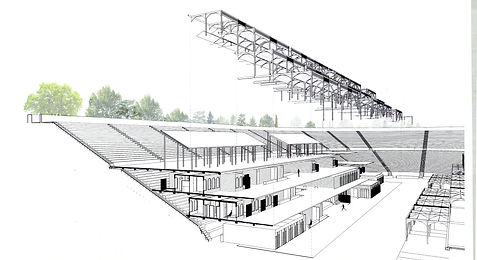
Philoxenia is a project proposing to establish a refugee welcome center in the Panathenaic Stadium in Athens during the migrant crisis caused by the Syrian conflict. The project for a welcome center for Syrian refugees becomes a socially and culturally charged proposal due to the context of the humanitarian crisis, as well as the placement of the proposal on the chosen site, the Panathenaic stadium. The humanitarian crisis brings both logistical and social challenges to the project, refugees are driven away from their home, culture, and everyday lives, being forced to travel or camp in unwelcoming environments. Logistically it becomes difficult to find space to care for refugees, requiring space and materials. The placement of the design also causes culture conflict within Athens, the site is charged with historical topos, symbolically tied to the spirit of cooperation and humanism, however it also is held in high regard as a monument to be preserved by the Greek state. The design aims to solve both the social and logistical challenges of the proposal by establishing a cultural dialogue between Syrian culture, the site’s context and Athenians, while using modular design strategies. The design aims to look from the perspective of the refugees, hoping to create a welcome and vibrant environment that restores humanity to a group torn from their traditions, built environment, and lifestyles.


The driving concept of the design is to create a cultural dialogue between syrian and athenian cultures within a modular design. The conceptual development began with looking at spatial and formal typologies of Syrian home and life architecture, as well as similar typologies found in Greek traditional architecture. By studying the cultural typologies, the design aims to create a spatial analogy to these spaces. Spaces studied include private family courtyards, social space, and individual formal expression. Next, spaces called souks, or market places are studied. They are similar to the spatial strategies of the Greek stoa, utilizing program space surrounded by covered circulation and activity space. However, the souk features two structures facing with a courtyard space between.
Design Approach

Courtyard
Stoa / agora
Beginning the design development, a modular frame work was explored. The framework utilizes the site’s dimensions and natural characteristics, attempting to make a physical connection with its surrounding. Within this framework, spatial relationships are established that aim to create a dialogue with cultural typologies. Using a modular frame system also allows for flexibility. Program becomes plugged into the frame work, allowing for modularity in a systems established around culturally analogous spatial relationships. Spaces of the framework are subtracted, creating courtyards that use the natural public spaces of the stadium. Under these spaces, activities such as meetings, socialization, recreation, and other forms of public interaction. These spaces aim to simultaneously tie the historical and symbolic history of the site with the lifestyles and environment of Syrian culture. Lastly, the spaces established by the frame work that are not dedicated for program is divided into two spaces: activity space, where the program is meant to filter out into a covered public space, and circulation space, these are meant to mimic the spaces of the souk and stoa.
Cultural Dialogue in Modular Design


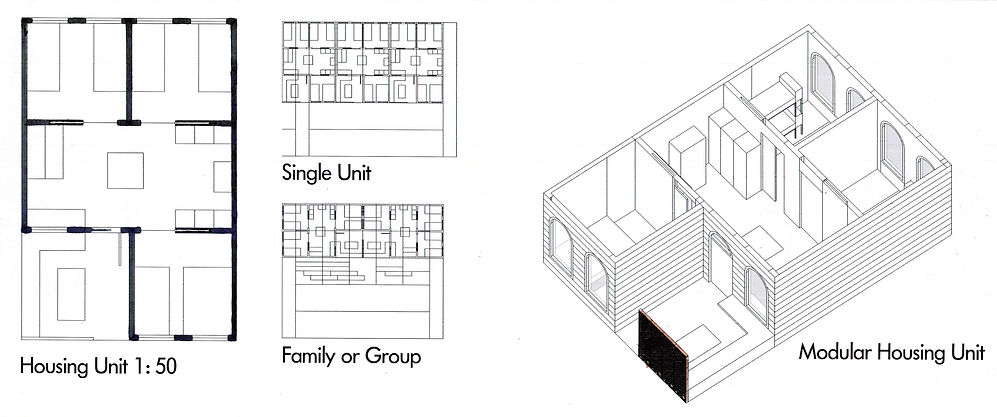
Modular housing units were created to provide temporary housing to refugees. Each unit can be placed within the framework modularly, and the pattern created establishes a small courtyard infront of the units. Each unit can be divided between single users, families, or groups.
Housing Units
Details
The design focus then moved to the details that could be used within the modular framework that could provide aesthetic connections to culture, and to create a vibrant space. Details used are motifs and patterns derived and abstracted from eastern design, such as screening systems that cover the courtyard spaces established by the housing units. Lastly, tensile structures are placed above the covered non program spaces to mimic the cultural connection of the design, as well as to mirror the flexibility of the design established by the framework.

Context:
Since the conflict and claimed civil war began in Syria in 2011 over 4,000,000 Syrian People have been forced out over the country due to the complete destruction of settlements and infrastructure, causing many to travel to surrounding countries to seek asylum. Another 7,000,000 are Internally Displaced within Syria. It is the worst humanitarian crisis since WWII. The conflict in Syria continues to drive people from there homes to seek safe refugee throughout Europe. Athens and many cities in the Mediterranean have seen an influx in refugee populations who are traveling through Europe for asylum. The project proposes the design of the first refugee center, inside Athen’s Panathenaic stadium. The site is meant to become an in transit node for refugees traveling to other parts of Europe, it offers logistical, registration , first aid and temporary accommodations for adults and children. The spaces in structures proposed are considered to be transportable, to migrate with to another site, or to become flexible to the humanitarian crisis.
The Panathenaic Stadium lies in a historical center of Athens Greece with close proximity to many of the city’s historic monuments and tourist destinations. Directly in front of the site runs one of the city’s main arterial streets connecting many nodes of the city, including the Port of Piraeus and the Airport. Surrounding the site is a dense portion of residential buildings with commercial bases. The entire surroundings are heavily trafficked by tourists and the city’s residents. It is also adjacent to the national gardens, near the Acropolis, Temple of Zeus, and many museums and civic centers. The site also holds symbolically charged history,it was originally established to host the Olympic games, and has help them in modern times also. It is held as a symbol of spirit, cooperation, and humanity. The site is chosen for its symbolic traditions, but also for its challenges, as it is cherished as a monument and by Greece, and is close to dense concentrations of both urban spaces and cultural monuments.

